
Why the most memorable tennis journeys are shaped by far more than the matches we play
There is always a moment when a tennis journey becomes something more.
It may happen during the first quiet hit of the morning, while the air is still cool and the day has not yet found its rhythm. It may happen over lunch, when a table of almost-strangers begins exchanging stories as though they have known one another for years. Or perhaps it happens much later, after the racquets have been packed away and the conversation continues beside a fire.
The court may be where we begin.
It is seldom where the journey ends.
At Baseline Africa, tennis is not simply an activity added to an itinerary. It is the thread that draws people together, leads them into unfamiliar places and gives each day its natural rhythm.
A morning match creates anticipation. A long lunch offers time to linger. The journey between one court and the next reveals landscapes that might otherwise have been passed too quickly.
The result is not only a tennis holiday. It is a more intimate way of experiencing South Africa.
The game gives us a reason to arrive
There is something wonderfully grounding about arriving in a new place with a racquet in your hand.
The court is familiar, even when everything around it is not. The lines remain the same. The ritual of warming up feels known. A ball travels across the net, and suddenly the distance between people begins to disappear.
Tennis creates an immediate point of connection.
You do not need to know someone’s profession, their history or what brought them there. You begin with a rally. You discover whether they come forward to the net, whether they laugh at their own mistakes and whether they become quietly determined when the score grows close.
Before long, you know something real about one another.
This is one of the reasons we believe tennis travel works so beautifully in small groups. The game allows people to meet without forcing conversation. Friendship develops in motion, often long before anyone sits down together around a table.
From court to coast
South Africa offers a rare combination of landscapes, cultures and playing environments within relatively short distances of one another.
A journey can begin beneath the mountain in Cape Town, continue through the vineyards of the Winelands and move towards the open air of the coast. Each destination changes the feeling of the game.
This is the spirit behind Court to Coast.
The experience moves through more than a sequence of tennis venues. It is a journey through contrasting landscapes, local flavours and different expressions of South African life.
One day may begin on a city court with Table Mountain holding the horizon. Another may unfold among vineyards, with a slow lunch waiting after the final match. Further along the journey, the air changes again as the road draws closer to the sea.
The tennis gives the experience structure, but the spaces between the matches are equally important.
There are roads worth travelling slowly. There are towns that reveal themselves over coffee rather than through a bus window. There are wine estates, coastal views and conversations with local people that become part of the journey’s deeper memory.
Court to Coast is shaped by movement, but it is not hurried.
It allows guests to experience the country through the rhythm of play, discovery and rest. Each day has a destination, but also enough space for the unexpected.
Courts beneath the trees
Where Court to Coast carries the energy of movement, Courts of the Forest invites a different pace.
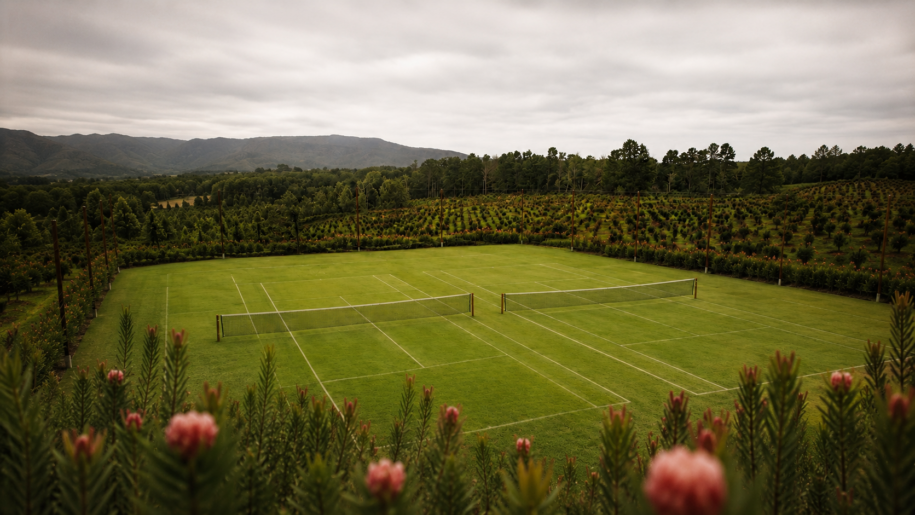
Set at Portland Manor in Rheenendal, near Knysna, the experience draws its character from the landscape around it. Old trees, heritage spaces and the quiet presence of the forest create an atmosphere that feels removed from the noise of ordinary life.
Here, the weekend unfolds gently.
There are grass and clay courts, structured play, shared meals and time to explore the stories of the place. There are moments of competition, but also long pauses between them. Guests may arrive for the tennis, yet find themselves remembering the firelight, the forest air or a conversation that continued well beyond dinner.
Courts of the Forest is not designed around the idea of fitting as much as possible into a few days.
It is designed around presence.
The presence of the landscape. The pleasure of playing on courts with character. The simple luxury of knowing that there is nowhere else you need to be.
This is a different kind of sporting escape. It is immersive without being overwhelming, structured without feeling rigid and refined without losing its warmth.
A destination experienced from within
There is a difference between visiting a place and becoming part of its rhythm, even briefly.
Traditional travel often places the traveller at a distance. You see the landmark, take the photograph and continue to the next stop.
Tennis changes that relationship.
Local courts are part of community life. They hold their own histories, personalities and rituals. When you play there, you experience the destination from within rather than looking at it from the outside.
You notice the way the morning light falls across the baseline. You hear the sounds beyond the fence. You meet the people who play there week after week.
The place becomes more than scenery.
It becomes part of the match.
This is especially meaningful in South Africa, where every region carries a distinct sense of identity. The courts of Cape Town do not feel like the courts of the Winelands. A forest estate offers a different rhythm from a coastal club. Even the surface beneath your feet changes the way you move, think and play.
Through tennis, the landscape becomes something you do not merely observe. You participate in it.
The intimacy of a small group
The most memorable journeys are often shaped by the people who share them.
Small-group travel allows connection to happen naturally. There is time to learn each guest’s rhythm, to adapt when needed and to make space for the moments that cannot be planned in advance.
A group may begin as a collection of individuals. Some arrive with a friend or partner. Others come alone. Most are uncertain, at least for a moment, about how the weekend will unfold.
Then the first match begins.
Partners rotate. Encouragement travels from one court to another. Someone tells a story over lunch. Another person orders a bottle for the table. By the final evening, the group has formed its own language, its own memories and its own collection of small jokes.
This is where travel becomes personal.
Not because every moment is perfectly choreographed, but because there is enough room for genuine connection.
What happens beyond the court
We remember matches in fragments.
A difficult point. A perfectly timed serve. A rally that lasted longer than expected. The satisfying sound of the ball meeting the centre of the racquet.
But the memories that remain are often found beyond the lines.
A table prepared after a long morning of play. A glass of wine catching the last light. The drive home through a landscape that seems to have changed while you were not looking. The warmth of a fire after the temperature drops. A conversation that begins casually and becomes unexpectedly meaningful.
These moments are not separate from the tennis experience.
They are part of it.
The game creates energy, focus and shared purpose. The hours around it offer time to soften, to listen and to encounter the destination through its food, people, history and landscape.
That balance matters to us.
We want our guests to play well, but we also want them to look up.
To notice where they are.
To feel that the journey has moved them in ways that cannot be recorded on a scorecard.
A deeper way to travel
At Baseline Africa, we believe luxury is not measured only by what is included.
It can be found in time that does not feel rushed. In a journey that has been thoughtfully shaped. In local knowledge, personal attention and the freedom to experience a place without feeling processed through it.
It is the luxury of arriving somewhere beautiful and being given a reason to stay a little longer.
Court to Coast and Courts of the Forest offer two distinct expressions of this philosophy.
One moves through city, vineyard and coastline.
The other settles beneath the trees.
Both begin with tennis. Both lead somewhere deeper.
Because the best journeys do not ask us simply to see more.
They invite us to feel more, connect more deeply and return home with something that cannot be packed into a suitcase.
The court is only the beginning.
The journey is everything that follows.